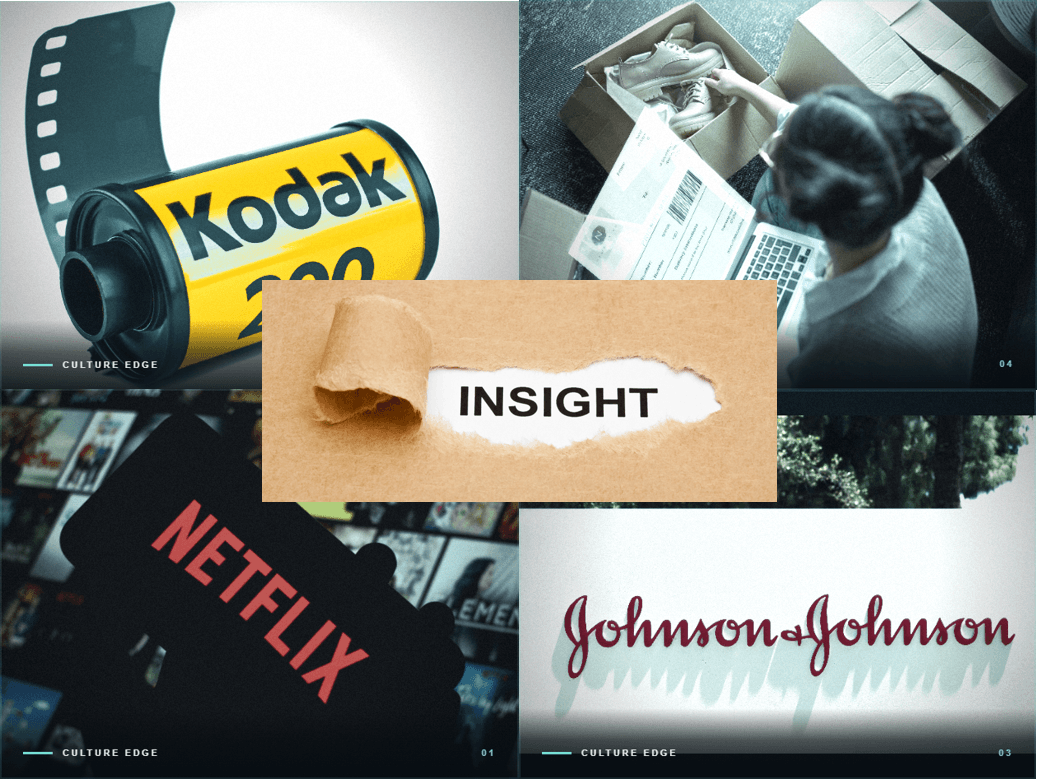
The four case studies used well-known organizations as their lens. The pattern they reveal belongs to every organization that has ever confused its mechanism for its purpose.
What you just read
Four organizations. Four different industries. Four stories that most people assume they already know.
Kodak invented digital photography and spent three decades unable to follow where its own invention was pointing. Netflix published the most cited culture document in Silicon Valley history and watched most organizations that tried to copy it produce chaos rather than freedom. Johnson & Johnson recalled 31 million bottles of Tylenol before the evidence was conclusive, at a cost of more than 100 million dollars, and returned to its pre-crisis market position within a year. Zappos built a culture so genuine that it became one of the most studied organizations in American business, and then discovered how fragile a living culture is when the conditions that produced it change.
The surface stories are entirely different. The pattern running through all four is the same.
Every case is a story about the distance between what an organization says it is and what it actually does. Between the vision it declares and the decisions that operationally serve it. Between the values it describes and the ones its people experience in their daily work. Between the beliefs it holds and the experiences it actually delivers to the people who depend on it.
That distance is not unique to Kodak, Netflix, Johnson & Johnson, or Zappos. It is not a consequence of their size, their industry, or their era. It is the most common and most consequential organizational challenge at any scale. And it tends to be invisible from inside the organization experiencing it, precisely because the people closest to the gap are also the most adapted to working around it.
The distance between what an organization says it is and what it actually does is the most common and most consequential organizational challenge at any scale. It tends to be invisible from the inside.
Why the distance grows without anyone deciding to grow it
The distance does not announce itself. It accumulates.
A vision is stated with precision at the founding and gradually becomes the language surrounding the mechanism that serves it, until the mechanism and the vision are no longer distinguishable. A mission that was once specific enough to govern real decisions becomes general enough to justify almost anything. Core values that were alive in the room where they were written become assumed by the people who inherit them, and assumed by the people who follow them, until they exist only in the document and not in the behavior. Beliefs about what each stakeholder deserves to experience are honored when they are convenient and quietly suspended when they are not.
George Eastman's vision was precise: to make photography as convenient as the pencil. Film was the mechanism. Memory was the purpose. When the mechanism became profitable enough, it stopped feeling like a means to an end and started feeling like the end itself. The gap between the vision and the operational reality grew slowly, invisibly, through individually defensible decisions that each made sense within the logic of the existing business model. By the time the gap became impossible to ignore, it had been growing for three decades.
Reed Hastings built three specific conditions before extending any freedom: talent density, radical transparency, and a culture of direct feedback. Organizations that copied the outcome, freedom and responsibility, without building the conditions that make it functional discovered that the language of trust, imported without the substance, produces confusion rather than performance. The gap between what those organizations said they were building and what their people were experiencing appeared quickly and often left the relationship between leadership and team worse than before.
James Burke found the gap between the Johnson & Johnson Credo and the organization's daily reality when he became CEO. He closed it before the crisis arrived. The executives who sat in the challenge meetings did not emerge with better talking points about the company's values. They emerged with genuine conviction, which is a different thing entirely. Conviction does not require a playbook to activate. When the journalist called in 1982, the decision about what to do was not made in that moment. It had already been made in the late 1970s, in rooms that had no particular urgency about them.
Tony Hsieh built something genuine at Zappos. A 75 percent repeat customer rate. A Net Promoter Score above 85. A talent culture that attracted people who wanted to be part of something larger than a job. What the second chapter of the Zappos story reveals is that a genuine culture and an institutional culture are not the same thing. A genuine culture is present and felt and real. An institutional culture is all of those things, and also embedded in systems that reproduce it when the people who created it are no longer in the room. Zappos built the first. The conditions that had sustained it changed faster than the infrastructure required to reproduce it.
A genuine culture and an institutional culture are not the same thing. A genuine culture is present and felt and real. An institutional culture is all of those things, and also embedded in systems that reproduce it when the conditions change.
The four foundations, named
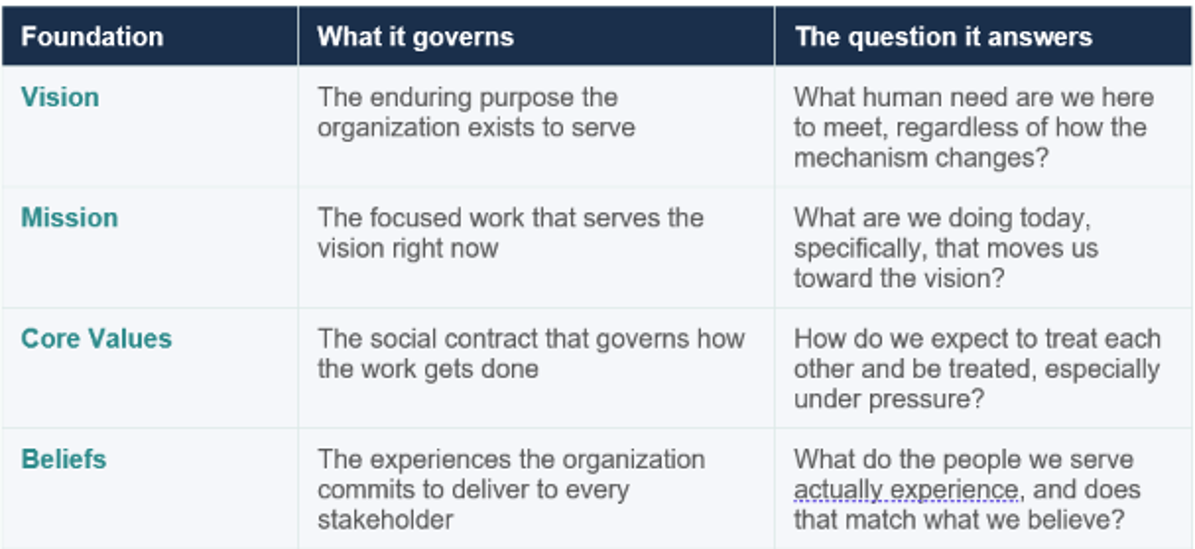
Reading the four case studies together, four distinct foundations emerge that distinguish the organizations and leaders documented in them from organizations that had comparable resources, comparable awareness, and less durable results.
They are not a checklist. They are four dimensions of the same organizational reality, each one dependent on the others, each one capable of being stated without being real. What makes them real is the same thing that made the Johnson & Johnson recall possible: the deliberate, uncomfortable work of examining them honestly before the environment demands it.
Foundation
Vision | Comfort Over Vision — Kodak
The vision that governs an organization is not always the one written in the founding documents. It is the one that actually determines which opportunities get pursued, which technologies get invested in, which decisions get made when two legitimate priorities come into conflict. Kodak's written vision, making photography accessible to ordinary people, described an enduring human need. Its operational vision, by the time the digital prototype arrived in 1975, had quietly become the preservation of film margins. The gap between the two was not visible in the language. It was visible only in the decisions. Organizations that want to know what their actual vision is should examine not what they say they are for, but what they consistently choose when the choice is hard.
Mission | No Rules Rules — Netflix
Netflix's mission is not stated in a single sentence anyone can easily cite. But it governs every significant product decision the company has made: remove every barrier between a person and the content they want. That mission drove the unlimited streaming model, the recommendation algorithm, the investment in local language content across every major market, and the mobile download feature for offline viewing. A mission doing its job is not aspirational language. It is the active criterion against which real decisions are evaluated in real time. The organizations that most need to examine their mission are the ones whose strategic communication points toward a purpose that their operational decisions no longer serve.
Core Values | The Culture Was Real — Zappos
The Zappos core values were developed through a year of genuine organizational involvement. Not written by a leadership team and communicated downward. Developed through a process that reflected what people throughout the company actually believed. The resulting values, including Create Fun and a Little Weirdness and Be Humble, were then embedded in hiring, performance, promotion, and the offer to pay new employees to leave if the culture was not genuinely right for them. The values worked while the conditions that had embedded them were intact. When those conditions changed, the values that had been genuinely held by specific people proved harder to reproduce in the people who followed them. Core values that live in individuals rather than in organizational systems are one leadership transition away from becoming decoration.
Beliefs | The Words That Hold — Johnson & Johnson
The Johnson & Johnson Credo named its stakeholders in a precise sequence: patients, doctors and nurses, mothers and fathers, employees, the communities it served, and owners. Each name describes a belief about an experience the organization committed to deliver. The belief about patients and families was delivered in the Tylenol recall: 31 million bottles removed before the evidence was conclusive, at a cost the company did not have to bear. When the belief was delivered as a genuine experience, a promise was secured. Not through the marketing that followed. Through the action that preceded it. Beliefs that describe experiences the organization genuinely intends to deliver are organizational commitments. Beliefs that describe experiences the organization would like to be known for are aspirational language. The difference between the two is only visible under pressure.
The four foundations are not a checklist. They are four dimensions of the same organizational reality, each one capable of being stated without being real. What makes them real is the deliberate, uncomfortable work of examining them honestly before the environment demands it.
What Working As 1 sees in these four cases
Working As 1 is an organizational development practice. The four case studies on this page were not written to illustrate a methodology. They were written because they are honest, well-documented accounts of organizations that either built the foundations that sustained genuine performance or discovered, at significant cost, what happens when the distance between the foundations and the daily reality grows too wide for too long.
What we see in these four cases is consistent with what we observe in the organizations we work with.
The foundations rarely fail independently. Kodak's vision eroded because the mission that should have kept it operational had quietly shifted from serving a human need to protecting a margin. Zappos' core values were genuine but not sufficiently embedded in the organizational systems that would have reproduced them across leadership transitions. Netflix's freedom was real but depended on three specific conditions being continuously maintained, and organizations that declared the freedom without building the conditions discovered how quickly the absence of those conditions produces the opposite of what the declaration intended.
The foundations also rarely appear in the form the organization believes they are in. The organization that is certain its vision is clear is often the organization that has stopped asking whether the operational decisions of the past five years still serve it. The organization that is proud of its core values is often the organization that has not recently examined whether those values govern behavior when honoring them is costly. The organization that believes its beliefs are reflected in the stakeholder experience is often the organization that has not asked the stakeholders.
The distance between what the organization believes its foundations are and what they actually are is the gap Working As 1 exists to close. Not after a crisis forces the examination. Before the conditions make the honest version of the examination feel unnecessary.
Five questions worth sitting with
These questions are not comfortable to answer honestly. They are worth asking precisely because they are not comfortable. The gap between the first answer and the honest one, when the question is held long enough that the defensive response has exhausted itself, is usually where the most important information lives.
What is the organization's actual vision — the one that governs decisions when two legitimate priorities conflict?
Not the written version. The operational one. When the organization had to choose between serving the long-term purpose and protecting the short-term mechanism, which did it choose? The pattern of those decisions describes the vision the organization is actually living by, regardless of what the founding documents say.
Is the mission specific enough to govern a real decision right now?
Take the most difficult strategic decision the organization is currently facing. Apply the mission to it. Does the mission point clearly toward one choice? If it is compatible with any reasonable answer, it is not a mission. It is a principle. A mission doing its job makes specific choices easier, not by prescribing them, but by making the criteria for evaluation clear.
Do the core values govern behavior when honoring them is costly?
The values that are honored only when convenient are preferences, not values. The test is the costly moment: the decision where living the value is genuinely expensive, in time, in money, in political capital, in relationships. Johnson & Johnson's values cost 100 million dollars and the temporary loss of 37 percent market share. That cost was the test. What the organization did in the face of it was the answer.
Do the beliefs the organization holds describe experiences that stakeholders actually receive?
Not the experiences the organization intends to deliver. The experiences stakeholders actually have. Zappos' beliefs about customer service were real for a decade because the operational system was aligned to deliver them. When the alignment shifted, the experiences shifted with it. The beliefs remained in the language while the experiences they described became inconsistent. The gap between the two is visible to every stakeholder. It is often invisible only to the organization itself.
Has the organization done the work of making its foundations real before the conditions that demand it arrive?
Burke's challenge meetings happened in the late 1970s, not in October 1982. The examination was done when the stakes were low enough to allow honest debate rather than defensive response. The conviction that acted in the crisis was built in the quiet before it. Every organization has the option to do that work before the environment makes it urgent. Almost no organization feels the urgency to do it until the environment has already made it necessary.
The gap between the first answer and the honest one, when the question is held long enough, is usually where the most important information lives. The foundations are revealed under pressure. The work of building them happens in the quiet before.
What the middle of the story looks like
The four case studies are told from vantage points that make their outcomes visible. Kodak's century of success followed by bankruptcy and rebirth. Netflix's cultural model and its wide influence. Johnson & Johnson's Tylenol response and the market recovery that confirmed it. Zappos' decade of genuine culture and the complexity that followed.
What the retrospective view tends to compress is the middle of each story. The years in which the foundations were being built, or eroding, without any visible signal that the outcome was already being determined.
Eastman's vision was precise for decades before the mechanism became the identity. The erosion was gradual. No single decision was the moment it happened. By the time it was visible, it had been accumulating through individually reasonable choices for twenty years.
Netflix spent years building talent density, radical transparency, and direct feedback before extending any significant autonomy. Freedom was the last thing they built, not the first. The organizations that copied the outcome and skipped the years of foundational work discovered the sequence matters in ways that are not visible from looking at the endpoint.
Burke's challenge meetings looked, from the outside, like an internal leadership exercise with no particular urgency. Their value became apparent only when the crisis arrived three years later and the examination that would otherwise have had to happen under pressure had already been done in conditions that allowed honesty.
Zappos' culture looked, from the outside, like the natural result of hiring the right people and treating them well. Its fragility only became visible when the conditions changed. What appeared to be a culture was, in significant part, a founder culture: genuine, but dependent on the founder's presence and daily expression to maintain its intensity at scale.
The middle of the story is where the foundations are actually built or actually erode. It is unglamorous, slow-moving, and invisible in the performance metrics until the conditions arrive that test what has actually been built. Building the foundations before that test arrives is the work. Recognizing that the work is ongoing, not completed, is the discipline.
What Working As 1 does
Working As 1 helps organizations examine the distance between the foundations they describe and the ones they are actually operating from.
We do not begin with a prescribed solution. We do not arrive with a framework to implement or a culture program to install. The four case studies on this page are studied carefully by us for exactly the reason they should be studied carefully by anyone who reads them: what produced the results in each case was specific to the organization, the people, the context, and the conditions that existed when the work was done. The lesson is not the method. The lesson is the distance between what the organization said it stood for and what its decisions actually served, and the quality of honesty that allowed each organization, at its best, to close that distance before it became irreversible.
What we do is help organizations develop that quality of honesty about their own specific situation.
We examine what the organization's operational vision actually is, not what it says, but what the pattern of its decisions reveals. We examine whether the mission is specific enough to govern real choices or general enough to justify almost anything. We examine whether the core values govern behavior when honoring them is costly, or only when it is convenient. And we examine whether the beliefs the organization holds about each stakeholder's experience match the experiences those stakeholders actually receive.
These examinations are not comfortable. The organizations that benefit most from them are the ones that already sense the distance. They can feel the gap between the performance they believe they are capable of and the performance they are currently producing. They have tried things that addressed the visible symptoms without closing the underlying distance. And they are ready to look honestly at the foundations rather than at the presenting problem, even when what that examination reveals is more complicated than the symptom suggested.
The how belongs to each organization. Making the distance visible, and naming it precisely enough that the right work can be applied to it, is what Working As 1 does.
If that is where your organization is, the conversation starts with a message.
Four organizations. Four different distances between what they said they were and what their decisions revealed. The ones that closed the distance before it became a crisis built something that held. The work of closing it is always available. The urgency to do it tends to arrive only after the conditions that make it feel optional have already changed.
References
Companion to the Culture Edge Case Studies