
The four case studies documented what championship performance looks like from the outside. This note explains what produces it from the inside.
The paradox in the name
Working As 1 is a deliberate paradox.
A team is not one person. It is many people, with different skills, different roles, different perspectives, and different relationships to the work. The leader who pretends otherwise produces a hierarchy, not a team. The manager who pretends otherwise produces compliance, not commitment. The player who pretends otherwise produces a solo performance, not a championship.
And yet the organizations that sustain genuine performance across time, in sport and in every other field, share a quality that is easier to name than to build: at their best, they think together, decide together, act together, and commit to the same goal together. Not because they are the same. Because they have learned how to be different people working as one.
That is the paradox the name describes. And it is the paradox the four case studies document from four different angles.
Phil Jackson did not produce eleven championships by managing Michael Jordan and Kobe Bryant. He produced them by building an environment in which two of the most gifted individual performers in the history of their sport learned to make everyone around them better rather than simply outperform everyone around them. The championships were the evidence. The working as one was the achievement.
Dale Hunter did not produce 28 simultaneous NHL players by identifying talent. He produced them by building a human environment in which every person, regardless of where they started, was held to the same standard and given the same conditions for development. Brandon Prust, undrafted by every OHL team, and Patrick Kane, the first overall NHL pick, received the same treatment. The program accumulated the skill, knowledge, and wisdom of every player who came through it, and the next generation of players inherited an environment made better by every predecessor.
Jon Cooper did not produce back-to-back Stanley Cup championships by coaching hockey systems. He produced them by caring about what his players were carrying in the 21 hours outside the rink, building trust deep enough that when the pressure was highest, the commitment was real rather than contractual. The performance in the three visible hours was the output of the 21 invisible ones.
Billy Beane did not produce 103 wins on a fraction of the Yankees payroll by finding better data. He produced them by asking an honest question about whether the organization's evaluation of people was measuring what actually determined their performance. The answer required him to challenge a century of professional certainty. What he built instead was an organization that could see its people more clearly than the systems it inherited had allowed.
The championships were the evidence. The working as one was the achievement. In every case, what produced the visible result was something built in the environment long before the result arrived.
What human-centered performance actually means
The phrase human-centered gets used casually. What these four cases make precise is what it actually requires.
A human-centered performance environment is not one in which people are treated kindly. Kindness is not the point. Hunter held his players to a standard that many of them found demanding. Cooper cared about his players' personal lives not as an act of warmth but because he understood that what was happening in those lives determined the quality of commitment available in the game. Jackson challenged Jordan and Bryant about their roles in ways that produced genuine conflict before they produced championships. Beane built a system that overrode the professional judgment of experienced scouts who had spent careers developing expertise he was now telling them was systematically wrong.
None of these leaders were soft. All of them were human-centered in the precise sense: they built environments in which the people inside them were seen clearly, developed genuinely, held to real standards, and trusted with real responsibility. The humanity was not a substitute for the performance demand. It was the foundation on which the performance demand could be met.
Cooper's language is the most direct. Players are with us for three hours a day. He cared about the other twenty-one. Not because the twenty-one hours were more important than the three. Because the twenty-one hours determined what was available in the three. The performance environment he built was human-centered because he understood that the person and the performer are the same person, and that an organization that only manages the performer is working with a fraction of what the person is capable of giving.
Jackson's language points at the same truth from a different direction. The leader who distributes power rather than hoarding it does not become less effective. The people around them develop their own genuine capability and commitment rather than simply executing instructions from above. The team that can function excellently when the leader is not directing it has been built on something real. The team that requires constant guidance has not.
Human-centered performance means building an environment in which the full capability of the people inside it is available to the collective goal. Not directed. Not managed into compliance. Available. Because the people inside it are genuinely seen, genuinely developed, genuinely trusted, and genuinely committed.
The intelligent operating system
What made the environments in these four cases sustainable was not the individual brilliance of the leaders who built them.
Hunter has coached the London Knights for 25 years. The program has won championships when he was present and when he was absent. When he left for Washington in 2011, his brother Mark stepped in as head coach and the Knights won the OHL championship that season. The program did not depend on Dale Hunter being behind the bench. It depended on a standard, embedded in the organization's culture and operations, that functioned regardless of who was holding it in any given moment.
That is what an intelligent operating system looks like in an organizational context. Not software. The accumulated skill, knowledge, experience, and wisdom that the organization has built through its history, made explicit enough to be transmitted, resilient enough to hold under pressure, and adaptive enough to improve as circumstances change. The organization that has built this system does not start from zero when people leave or circumstances shift. It starts from everything it has learned.
Working As 1 calls the four pillars of this system Communication, Capacity, Capability, and Connection. Together they describe the complete cycle through which an organization builds shared understanding, converts it into structure, develops the people to execute within that structure, and builds the relationships that allow individual execution to become collective performance. When all four pillars are functioning and calibrated to each other, the organization has built something that outlasts any individual within it.
Working As 1 asks
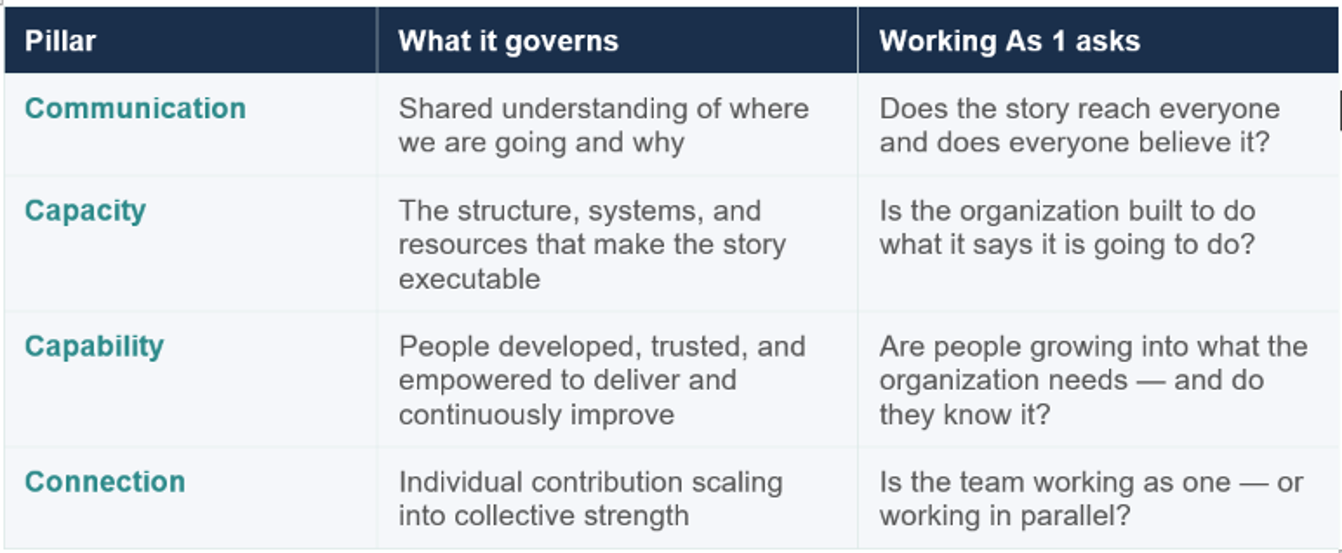
The gaps in organizational performance, the distances between what an organization is capable of and what it is currently producing, live in the spaces between these pillars. When Communication and Capacity fall out of alignment, direction exists but the structure to pursue it does not. When Capacity and Capability fall out of alignment, plans exist but the people cannot yet carry them. When Capability and Connection fall out of alignment, people are capable individually but do not perform as a team. When Connection and Communication fall out of alignment, what the team learns never feeds back into how the organization improves.
Each of the four case studies documents a leader who closed one of these gaps, built the corresponding pillar relationship, and in doing so built something that the individual talent in the organization had not previously been able to produce together.
The organization that has built an intelligent operating system does not start from zero when people leave or conditions change. It starts from everything it has learned. That accumulated intelligence is what the four pillars are designed to build and protect.
What becomes visible when the team works as one
There is a quality in championship teams that is easier to observe than to explain. It is the quality Jon Cooper described as the other twenty-one hours. The quality Phil Jackson pointed at when he said the leader who lets go of power becomes more powerful. The quality Dale Hunter built into a standard that produced the same result regardless of who arrived. The quality Billy Beane accessed when he asked honestly whether the system was measuring what it was supposed to measure.
It is the quality that makes the sum of the team more than the sum of its parts.
In sport it shows up in the moments that cannot be scripted: the player who makes the right decision under pressure without being told what to do, because the standard is so deeply internalized that the right decision feels obvious. The team that holds its approach when the game is closest, because the commitment is real rather than circumstantial. The organization that produces its best performance precisely when the conditions are most difficult, because the foundation was built for difficulty, not for ideal conditions.
In organizational life it shows up in the same moments, less visibly but no less consequentially. The person who makes the right call without escalating, because they understand the direction clearly enough to know what it requires of them. The team that coordinates without friction, because the relationships are strong enough to carry the load that formal structure alone cannot. The organization that gets better as it grows, because what it has learned is embedded in how it operates rather than held in the heads of the people who have been there longest.
These are the outcomes of working as one. They do not appear at the beginning of the process. They appear after the pillars have been built, the gaps have been closed, and the organization has accumulated enough shared experience to produce collective intelligence rather than just coordinated individual effort.
They are also the outcomes that most organizations say they want and that most organizational initiatives fail to produce. Not because the leaders do not care. Because the environment that produces these outcomes requires specific conditions to be built and held, in a specific sequence, over a period of time that most improvement initiatives do not allow for.
The sum that makes the invisible visible
There is a line in each of the four case studies that points at the same thing.
Beane's line is about the picture. The organization had been measuring something visible, the image of a successful player, and calling it accurate evaluation. What was invisible was the contribution that did not match the picture but determined the outcome. Making it visible required asking honestly whether the picture was measuring the right things.
Hunter's line is about the standard. The organization said it held one. What was invisible was whether it held consistently, for every person, in the moments when consistency was most costly. Making it visible required holding the standard precisely when holding it was hardest.
Cooper's line is about the hours. The organization managed three. What was invisible was the twenty-one that determined what was available in the three. Making it visible required caring about what the organization had decided was not its business.
Jackson's line is about the team. The organization had extraordinary individuals. What was invisible was the collective they had not yet become. Making it visible required building a system in which individual excellence made everyone better rather than simply outperforming everyone else.
In each case, the visible result, the championships, the development records, the sustained performance, was the evidence of something invisible being made real. The working as one that produced the visible outcome was built in the environment, over time, through the specific kind of leadership that is less interested in demonstrating capability than in building it in others.
That is what Working As 1 exists to build. Not the visible result, which is each organization's own to produce. The environment, the pillars, the calibration between them, and the accumulated organizational intelligence that makes the visible result possible.
What Working As 1 does
Working As 1 is an organizational development practice. We work with organizations that already sense the gap between the performance they are capable of and the performance they are currently producing.
Our work examines the four pillars of the i4CS framework and the spaces between them, identifying where the organization is strong, where it is constrained, and what the specific nature of each constraint is. The instrument we use for this examination is the Competitive Wellness Assessment, a diagnostic tool built around the four pillars and the six gaps that live between them.
The CWA produces a precise picture of where each pillar stands and where the calibration between pillars has opened a gap. It does not prescribe what to do with that picture. What the organization builds from the picture is built by the organization's own leaders, from their own understanding of their own people and their own context.
The how belongs to each organization. Building the conditions in which their people can work as one is the work that follows the finding.
If your organization already senses the gap between what it is capable of and what it is currently producing, the conversation about where it lives and what closing it requires starts with a message to Working As 1.
Leadership, management, and the people doing the work thinking together, deciding together, acting together, committing to the same goal together. That is what Working As 1 means. And that is what the four case studies, across four different sports and four different eras, document from the inside.